Views: 0 Author: Site Editor Publish Time: 2026-04-26 Origin: Site
Imagine an excavator effortlessly lifting tons of materials, the landing gear of a large aircraft smoothly and powerfully retracting and extending, or a press machine in a factory precisely shaping metal parts with tremendous force. Behind these impressive mechanical powers lies a common and efficient power core - the hydraulic system.
Hydraulic technology is the cornerstone of modern industry and mobile machinery. With its extremely high power density (able to generate huge forces in a compact space), smooth and precise control capabilities, and outstanding reliability, it is widely applied in key fields such as construction machinery, aerospace, industrial manufacturing, and transportation. Understanding how hydraulic systems work is not only a necessary course for engineers but also helps equipment users, purchasers, and decision-makers to better select, use, and maintain these critical devices.
This article will present the entire process of the hydraulic system, from its basic principles to practical applications, in an easy-to-understand manner. It will enable you to gain a deep understanding of the mystery of this "fluid force".
The operation of all hydraulic systems is based on an ancient physical principle - Pascal's Law. This law was proposed by the French scientist Blaise Pascal, and its core content is: the pressure acting on any part of a closed fluid will be transmitted in all directions by the fluid, in the same magnitude as it was originally.
This might sound a bit abstract, but a simple experiment can help us understand it intuitively: Take a syringe, seal its outlet, and then push the piston forcefully. You will find that no matter where your finger presses on the piston, the same amount of force is required to push it, because the pressure is evenly transferred to every surface in contact with the liquid.
The more crucial application lies in the amplification of force. Imagine two cylindrical containers of different diameters connected by a pipe and filled with liquid, forming a closed system. Apply a relatively small force on the smaller piston. Since the pressure (force per unit area) is uniformly transmitted through the liquid, a much larger total force will be generated on the contact surface of the larger piston. This is because the larger piston has a larger area, and the same pressure acts on a larger area, resulting in a proportional amplification of the total force. This is the fundamental reason why hydraulic systems can "move a thousand pounds with just two ounces".
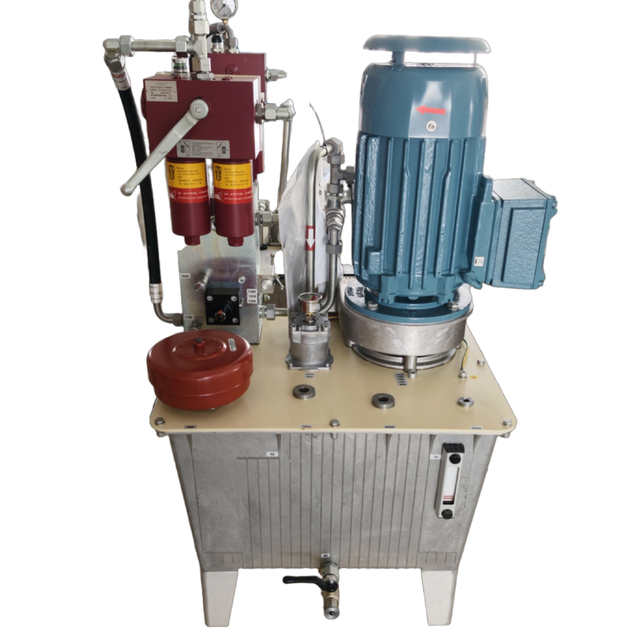
A complete hydraulic system is like the circulatory system of the human body, with multiple "organs" working together. The following figure clearly shows the positions and relationships of the core components in a basic system:
Next, let's delve into the functions and types of each core "organ".
The hydraulic pump is the power source of the system. Its core task is to convert the mechanical energy (rotational torque and speed) input by the prime mover (such as an electric motor or an internal combustion engine) into hydraulic energy, that is, to output oil with flow rate and pressure. It achieves this by the periodic change of its internal volume, creating a vacuum to draw oil from the oil tank and then forcing the oil to be pushed into the outlet pipeline.
Based on their structure and working principle, the mainstream hydraulic pumps can be classified into three main categories:
Gear pump: The structure is the simplest, the cost is low, and it has strong resistance to contamination. However, its volumetric efficiency and pressure are usually lower. It is often used in medium-low pressure systems with low performance requirements or as an auxiliary oil source.
Vane pump: The flow output is uniform, the operating noise is low, and the lifespan is long. It is divided into single-acting (variable) and double-acting (constant) types, and is widely used in medium-pressure industrial systems.
Plunger pump: The technology is the most complex, the efficiency is the highest, and the working pressure it can achieve is also the highest. It can be further classified into axial plunger pumps and radial plunger pumps, and it can easily achieve variable function (that is, the output flow can change according to needs), making it the preferred choice for high-performance and high-precision hydraulic systems, commonly found in construction machinery and injection molding machines, etc.
The actuating elements are responsible for converting hydraulic energy back into mechanical energy to drive the load to perform work. There are mainly two forms:
Hydraulic cylinder: Achieves linear reciprocating motion. High-pressure oil enters one end of the cylinder, pushing the piston rod to extend or retract, thereby generating actions such as pushing, pulling, lifting, and pressing. Depending on the way the oil acts, it can be divided into single-acting cylinders (only one direction is driven by hydraulic pressure, and the return stroke relies on a spring or external force) and double-acting cylinders (extension and retraction are both driven by hydraulic pressure, and are the most widely used).
Hydraulic motor: Achieves continuous rotational motion. Its principle can be regarded as a reversible pump. When high-pressure oil enters, it drives the output shaft to rotate, generating torque. Compared with an electric motor of the same power, hydraulic motors have the advantages of large starting torque, stepless speed regulation, not afraid of frequent starts and reversals, etc.
The flow of oil in the hydraulic valve control and regulation system is crucial for achieving various complex actions and ensuring the safety of the system. It is mainly divided into three categories:
Direction control valve: Such as the electromagnetic directional valve, which is used to connect, cut off, or change the direction of the oil circuit, thereby controlling the start, stop, and movement direction of the actuating element.
Pressure control valve: Such as the relief valve, which is used to limit the maximum working pressure of the system, prevent overload, and provide safety protection; the pressure reducing valve provides a stable lower pressure for the branch circuits.
Flow control valve: Such as the throttle valve and the speed control valve, which adjust the flow into the actuating element by changing the size of the oil circuit's flow passage, thereby precisely controlling its movement speed.
Hydraulic oil: Not only is it the medium for transmitting power, but it also serves the functions of lubrication, cooling, and rust prevention. Its viscosity, cleanliness, and chemical stability are of vital importance.
Oil tank: Stores the oil, dissipates heat, separates inhaled air and sediment impurities.
Filter: Removes particulate contaminants from the oil, is the "guardian" ensuring the reliability and lifespan of the system components. The precision grade is selected according to the system requirements.
Pipes and joints: Include steel pipes, hoses, and various joints, forming the "vascular network" for transporting the oil, which must be able to withstand system pressure and have good sealing.
Cooler and heater: Maintain the oil temperature within the optimal working range (usually 40-60°C). Excessive temperature will accelerate the aging of the oil, while too low a temperature will increase viscosity.
Energy input: The prime mover is activated, and the shaft driving the hydraulic pump starts to rotate.
Energy conversion (mechanical energy → hydraulic energy): The rotating pump draws oil from the oil tank through its inlet and discharges high-pressure oil with a certain flow rate and pressure at its outlet.
Energy regulation: The high-pressure oil flows through the control valve group. The direction valve determines the direction of the oil flow to which actuator it goes; the pressure valve ensures the safety of the system pressure; the flow valve precisely controls the oil flow to adjust the speed.
Energy output (hydraulic energy → mechanical energy): The controlled high-pressure oil enters the hydraulic cylinder or hydraulic motor. For the hydraulic cylinder, the pressure acts on the piston to generate linear thrust; for the hydraulic motor, the pressure drives the rotor to generate rotational torque.
Energy recovery and circulation: The low-pressure oil from the other side of the actuator flows out, passes through the return oil pipeline and filter, and returns to the oil tank to complete a working cycle. The heat generated by the system is mainly dissipated through the surface of the oil tank and/or an independent cooler.
Key types of hydraulic systems
Open system: The pump sucks oil from the oil tank, and the oil discharged by the actuator directly returns to the tank. This system has a simple structure, good conditions for heat dissipation and impurity sedimentation, and a larger oil tank volume. It is the most widely used type.
Closed system: The oil outlet of the actuator is directly connected to the suction port of the pump, forming a closed loop. An auxiliary pump is needed to replenish the leaked oil and control the pressure. This system is compact in structure, has high efficiency, and air is less likely to enter. However, it is more complex and is often used in static pressure transmission of mobile machinery.
Extremely powerful force amplification capability: It can generate hundreds or even thousands of tons of force within a very small installation space.
Smooth and precise control: Achievable with stepless speed regulation, the movement is smooth and the positioning is precise.
Flexible layout: The power can be conveniently transmitted to any location through pipelines, and the actuators can be far away from the power source.
Safe and reliable: Easy to implement overload protection, and the risk of system failure is relatively low.
Examples of Application Fields
Construction machinery: Excavators, loaders, bulldozers, truck cranes (almost all movements are driven by hydraulics).
Industrial manufacturing: Injection molding machines, hydraulic presses, die-casting machines, feed and clamping mechanisms of machine tools.
Transportation: Brake systems of automobiles (master cylinders/fraction cylinders), landing gear and control surfaces of aircraft, rudder systems of ships.
Agricultural machinery: Lifters of tractors, control mechanisms of combine harvesters.
The reliability of the hydraulic system largely depends on maintenance. The key lies in keeping the oil clean, controlling the oil temperature and preventing leaks.
Common Fault Troubleshooting:
System sluggishness or inability to operate: Possible causes include wear and leakage of the hydraulic pump, low or damaged set pressure of the relief valve, excessive leakage in the actuator or valve, improper oil viscosity or clogged filters.
Abnormal noise and vibration: May be caused by pump suction failure (blocked oil inlet pipeline or air leakage), cavitation, damage to pump or motor bearings, or excessive air mixed in the oil.
High oil temperature: May be due to failure of the cooler, severe internal leakage in the system resulting in energy loss, excessively high pressure setting, or improper selection of oil viscosity.
The hydraulic system is a technology that perfectly integrates fluid mechanics with mechanical engineering. Based on the fundamental principle of Pascal's law, through the precise cooperation of core components such as pumps, valves, cylinders, and motors, it achieves efficient and controllable transmission and conversion of energy, becoming an indispensable power pillar in modern industry.