loading
| Availability: | |
|---|---|
| Quantity: | |


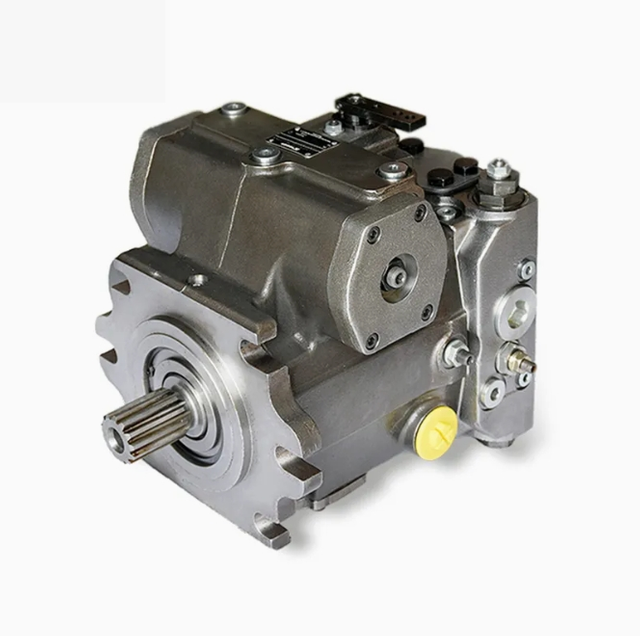
A7VSO
REXROTH
The A10VSO / A10VO / A4VSO series hydraulic piston pumps are high-performance variable displacement pumps designed for open-circuit hydraulic systems in mobile and industrial applications. Proper hydraulic oil selection, viscosity control, filtration, and temperature management are critical to achieving optimal efficiency, service life, and operational reliability.
This guide provides essential technical instructions for hydraulic oil selection, operating limits, and system design considerations.
The pumps are designed for use with hydraulic oil. For detailed oil selection and application conditions, please refer to the following technical data sheets:
RC90220 – Mineral Hydraulic Oil
RC90221 – Environmentally Friendly Hydraulic Oil
RC90223 – HF Flame-Retardant Hydraulic Oil
A7VO variable pumps are not suitable for HFA fluids
When using HFB, HFC, HFD, or environmentally friendly hydraulic oils, all limitations regarding technical parameters and sealing materials stated in RC90221 and RC90223 must be strictly followed
The hydraulic oil type must be specified in writing when placing an order
To ensure maximum efficiency and extended service life, the recommended operating viscosity is: Vopt (Optimal working viscosity): 16 – 36 mm²/s
Oil tank temperature (open circuit) must be considered when selecting viscosity.
| Condition | Viscosity |
|---|---|
| Minimum viscosity (Vmin) | 5 mm²/s (short-term < 3 min) |
| Maximum viscosity (Vmax) | 1600 mm²/s |
| Maximum oil temperature | +115 °C |
Short-term cold start conditions (< 3 min):
Pressure: ≤ 30 bar
Speed: ≤ 1000 rpm
Minimum temperature: −40 °C
⚠ Special measures are required for operation between −40 °C and −25 °C. Please contact our technical team.
For low-temperature operation details, refer to RC90300-03 B.
Correct oil selection requires knowledge of the operating temperature relative to ambient temperature.
In open circuits, this refers to the oil tank temperature
The selected hydraulic oil must ensure working viscosity remains within Vopt (16–36 mm²/s) across the operating temperature range
Higher viscosity grades are recommended within the optimal range
Example:
At an ambient temperature of X °C and a circuit temperature of 60 °C, viscosity grades VG46 or VG68 may be suitable. In this case, VG68 is recommended for better protection.
⚠ Important Temperature Notes
Leakage oil temperature is always higher than circuit temperature
Oil temperature must never exceed 115 °C at any point in the system
Localized areas (e.g., bearings) may run up to 12 K above average discharge temperature
For extreme conditions, bearing flushing via the U port is recommended.
Oil cleanliness directly affects pump lifespan and reliability.
ISO 4406: 20 / 18 / 15
ISO 4406: 19 / 17 / 14
If these cleanliness levels cannot be achieved, please contact our technical support team for system optimization recommendations.
The leakage chamber is internally connected to the suction chamber
No external return line to tank is required (both R ports remain blocked)
Exception:
For pressure control or pressure cut-off systems, a leakage line must be connected between port T1 and the oil tank
Maximum allowable leakage pressure during deceleration: 6 bar (absolute)
Short-term peak pressure (< 5 s): 10 bar (absolute)
Recommended continuous average leakage pressure: ≤ 3 bar (absolute)
Frequent pressure peaks will significantly reduce shaft seal service life.
Maximum shell resistance: 20 bar
Fluororubber (FKM) shaft seal operating range:
−25 °C to +115 °C
Mobile machinery (construction, mining, agricultural equipment)
Industrial hydraulic power units (HPU)
Metallurgy & heavy industry systems
Energy, petrochemical, and process equipment
1. Variable dual pump, equipped with two axial conical piston rotating groups, used for static hydraulic drive in open circuits.
2. Motion is proportional to the entering speed and displacement, from qV max to qV min.
3. The pump is suitable for direct installation in the flywheel environment of a diesel engine.
4. A special typical suction port for auxiliary pump and each circuit.
5. A wide range of management instruments can be provided for various control and regulation functions.
6. A separate power controller.
7. Built-in auxiliary pump, with pressure - relief valve as an optional additional force - relief valve.
8. Energy release - for installing axial piston and equipment pump.
9. Outstanding energy-to-weight ratio.
1. The installation location can be chosen freely. During the trial operation, the pump body must be filled with oil pressure fluid and kept filled during operation. To reduce noise, all connection pipes (inlet pipe, pressure oil pipe and shell oil discharge pipe) need to be isolated by flexible elements and separated from the oil tank.
They can fully absorb vibrations.
2. The pump support base should be firm and have good rigidity.
3. The concentricity of the pump and motor shafts should be controlled within 0.100mm. Try to use flexible coupling to avoid the pump shaft from bearing bending moments and axial loads.
4. The inlet pipe diameter of the oil pump should be no less than the pump inlet diameter. The flow passage of the oil suction device should be no less than twice that of the oil pump. The finer the oil filtration, the better the cleanliness of the working fluid, and the longer the life of the oil pump.
5. When the pump is installed higher than the oil tank, the height from the inlet of the pump to the oil liquid surface should be less than 1 meter (for phosphate ester or water-containing hydraulic fluid, it should be less than 0.8 meters).
6. When the pump is installed higher than the oil tank liquid surface, the inlet of the pump should be upward.
7. Pay attention to the flange, joint and the entire oil suction pipeline at the inlet must be strictly sealed to prevent air leakage. Otherwise, it will cause noise, system vibration, and cause large bubbles in the oil tank, reducing the pump's performance.
8. The oil tank should have a partition to separate the bubbles and dirt brought by the return oil. The return oil pipe should extend below the oil surface (it should not be directly connected to the pump's inlet), to prevent the return oil from causing bubbles.
1. After purchasing the oil pump, if it is not used promptly, it should be filled with anti-rust oil, the exposed surfaces should be coated with anti-rust oil, and then the oil ports should be covered with dust covers.
2. The safety shut-off pressure should not be too high. Generally, it should be 1.25 times the rated pressure of the pump.
3. Keep the oil within the range of 10-60°C. Especially, avoid continuous high-speed operation, otherwise the pump will be significantly shortened. If necessary, a heater and cooling device should be set up.
4. Maintain the normal oil level. An oil level gauge should be set in the oil tank to allow for regular observation and oil replenishment.
5. Regularly check the performance of the oil. If it does not meet the specified requirements, it should be promptly cleaned and the oil tank refilled.
6. The oil filter should be cleaned frequently to ensure smooth oil intake.
7. After the oil pump has been working for a period of time (due to vibration), the installation screws or the flange screws at the inlet and outlet oil ports may become loose. Pay attention to checking and tightening them to prevent loosening.
8. The maximum hydraulic force of the system should not exceed 14 Mpa.
9. To obtain the correct hydraulic oil, it is necessary to know the relationship between the working temperature of the oil in the oil tank (open circuit) and the ambient temperature. The leaked oil (the temperature of the oil leakage from the housing is affected by the pressure and speed of the pump and is always higher than the oil temperature in the oil tank. However, the maximum temperature at any point in the system should not exceed 90 degrees.)