Views: 0 Author: Site Editor Publish Time: 2026-07-31 Origin: Site
Operating heavy machinery leaves zero room for fluid guesswork. Walk onto any job site, and you will likely find a reservoir cap stamped simply with the word "OIL." This ambiguous label frequently leads operators to grab whatever 15W-40 is sitting in the lube truck. Substituting engine oil for dedicated hydraulic fluid is a high-stakes error that happens more often than maintenance managers care to admit. Operating industrial equipment requires strict adherence to fluid specifications. Pouring the wrong bucket into a Hydraulic System triggers catastrophic component failure, unplanned downtime, and voided warranties. We are moving past anecdotal workshop advice to evaluate fluid properties, additive packages, and OEM specifications. You need to understand exactly how engine oil impacts pump internals, why these fluids possess fundamentally opposed chemistries, and the exact steps to take when a mix-up occurs on your site.
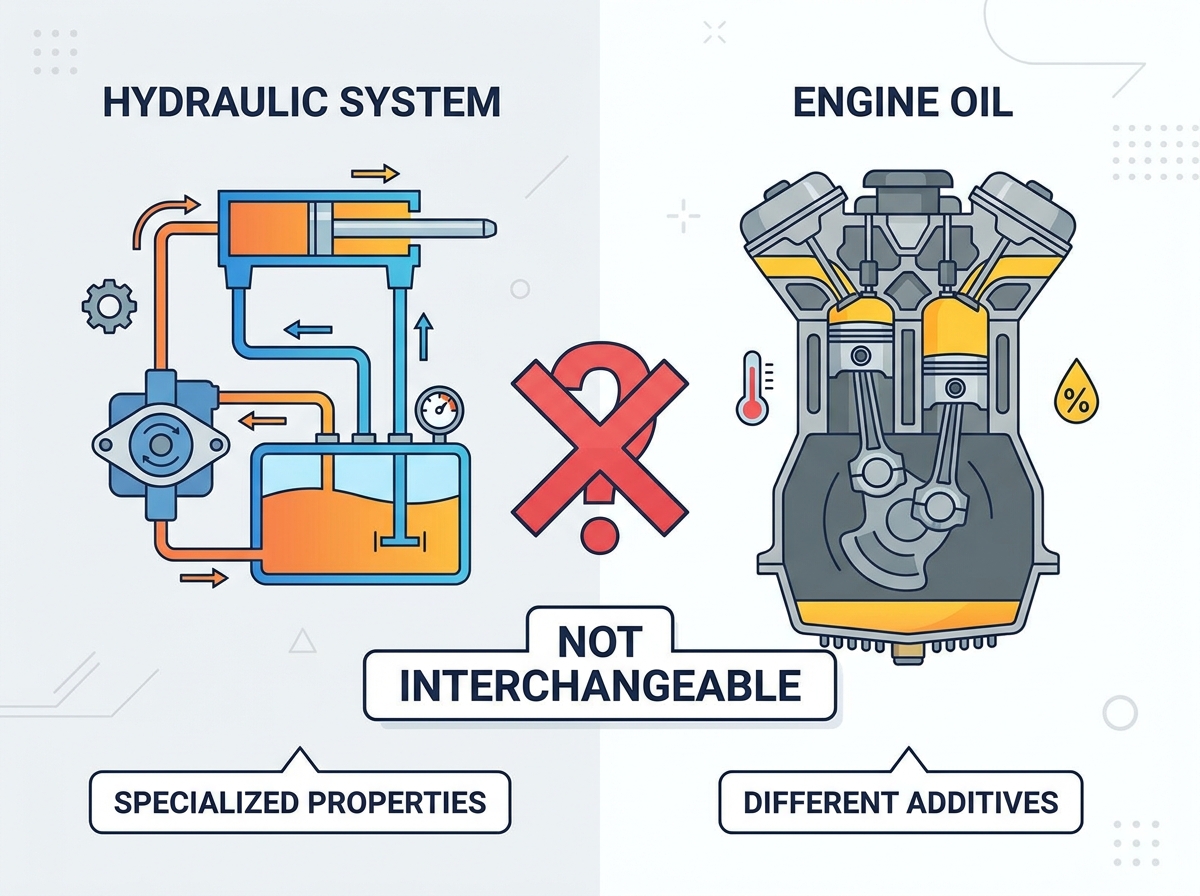
Fundamental Incompatibility: Engine oils and hydraulic fluids are engineered for entirely different operating environments; engine oils suspend contaminants, while hydraulic oils separate them.
Severe Component Risk: Introducing standard engine oil into a dedicated hydraulic system can cause foaming, cavitation, seal degradation, and accelerated pump wear.
OEM Exceptions Exist: Certain heavy mobile equipment manufacturers explicitly specify single-grade or multi-grade engine oils for their hydraulic systems, making the equipment manual the ultimate authority.
Immediate Action Required for Mix-Ups: Accidental contamination requires immediate assessment of the volume mixed, followed by potential system flushing and fluid analysis to prevent long-term damage.
Table of Contents
Hydraulic fluids and engine oils rely on entirely different grading systems to classify their flow characteristics. Hydraulic fluids are categorized by the International Organization for Standardization (ISO) Viscosity Grade (VG) system. This system measures the fluid's kinematic viscosity at 40 degrees Celsius. Common industrial grades include ISO VG 32, 46, and 68. Engine oils use the Society of Automotive Engineers (SAE) grading system, which evaluates viscosity at both cold cranking temperatures and operating temperatures of 100 degrees Celsius, resulting in designations like 10W-30 or 15W-40.
The viscosity index (VI) dictates how much a fluid's viscosity changes in response to temperature fluctuations. A higher VI indicates greater stability. This stability directly determines the safe operating temperature limits of your equipment. When a machine starts cold, the fluid must be thin enough to flow into the pump inlet without causing starvation. As the machine reaches operating temperature, the fluid must remain thick enough to seal the microscopic gaps between moving parts.
Temperature fluctuations impact the flow rates of ISO VG fluids differently than SAE multi-grade oils. In high-pressure loops, hydraulic fluids are formulated to maintain a consistent, predictable flow rate. Engine oils contain polymeric viscosity modifiers designed for the extreme heat of internal combustion. When subjected to the mechanical shear forces inside a hydraulic pump, these modifiers can break down rapidly, causing the engine oil to thin out and lose its protective film thickness.
Feature | Hydraulic Fluid (ISO VG) | Engine Oil (SAE) |
|---|---|---|
Grading Standard | ISO VG (measured at 40°C) | SAE (measured at 100°C & cold crank) |
Viscosity Modifiers | Highly shear-stable, minimal polymers | Heavy use of polymers for multi-grade |
Primary Function | Power transmission and heat transfer | Lubrication and soot suspension |
Temperature Focus | Consistent ambient to moderate heat | Extreme combustion temperatures |
The most significant divergence between these two fluids lies in their chemical additive packages. Engine oils contain heavy doses of metallic detergents and ashless dispersants. Internal combustion engines generate soot, unburned fuel, and acidic byproducts. The detergents neutralize the combustion acids, while the dispersants surround soot particles, keeping them suspended in the oil. This suspension prevents sludge buildup on engine internals and allows the oil filter to capture the debris.
Hydraulic fluids operate in a completely different reality. They require demulsifiers. Water inevitably enters hydraulic reservoirs through condensation or compromised breather caps. Demulsifiers force water to separate from the oil, allowing it to pool at the bottom of the tank where maintenance crews can drain it. Hydraulic systems rely on the fluid to shed water rapidly to prevent rust and maintain lubricity.
Putting detergent-rich engine oil into a system built for demulsifying hydraulic fluids creates a chemical clash. The engine oil's detergents will grab onto any moisture in the reservoir and emulsify it. This creates a milky, unfilterable mixture. Emulsified water destroys the fluid's film strength, promotes rapid oxidation, and leads to severe wear on pump internals. You cannot filter out emulsified water with standard cellulose elements.
Industrial pumps operate under immense pressure, often exceeding 3,000 PSI. To survive these loads, hydraulic fluids utilize specific anti-wear compounds, most commonly Zinc Dialkyldithiophosphate (ZDDP). These additives activate under heat and pressure to form a sacrificial chemical film on metal surfaces. This film prevents metal-to-metal contact inside gear teeth, vane tips, and piston shoes.
Engine oils also contain anti-wear additives, but their formulation is balanced against the need to protect catalytic converters and manage combustion byproducts. Furthermore, the viscosity modifiers in engine oil break down under the high mechanical shear stress unique to a hydraulic system pump. Shear stability is non-negotiable in hydraulics. Fluid is forced through incredibly tight tolerances at high velocities. Engine oils lose their viscosity rapidly under these conditions, leading to internal bypass and overheating.
Standard engine oils also lack the specialized anti-foaming agents found in purpose-built hydraulic fluids. Hydraulic systems require rapid air release. If air becomes entrained in the fluid, it must rise to the surface of the reservoir and dissipate quickly. Engine oils, due to their heavy detergent load, tend to hold onto air bubbles, leading to spongy cylinder operation and severe pump damage.
When you introduce engine oil into a hydraulic loop, the detergent package immediately begins trapping air. This aeration causes the fluid to foam. Foamy fluid has a lower bulk modulus, meaning it becomes compressible. Hydraulic systems rely on fluid incompressibility to transmit power instantly. Aerated fluid makes actuators spongy, causes cylinders to drift, and makes the entire machine unresponsive to operator inputs.
This aeration leads directly to cavitation. Cavitation occurs when trapped air bubbles are subjected to rapid pressure changes inside the pump. As the fluid moves from the low-pressure inlet to the high-pressure outlet, these air bubbles violently implode. The implosions generate microscopic shockwaves and localized temperatures exceeding 1,000 degrees Celsius. These micro-jets physically pit and tear metal away from pump internals. Cavitation sounds like marbles rattling inside the pump housing and will destroy a new component in a matter of hours.
Fluid compatibility extends beyond metal components; it directly impacts the elastomers used for sealing. Hydraulic cylinders, valves, and pumps rely on seals made from materials like Nitrile (Buna-N), Viton, or Polyurethane. These materials are engineered to interact with specific base oils and additive packages to maintain their durometer (hardness) and physical dimensions.
Engine oil additives are often chemically incompatible with standard hydraulic seals. The aggressive detergents and dispersants can extract the plasticizers from the elastomer. This chemical attack causes the seals to shrink, harden, and eventually crack. Alternatively, certain base oil compositions can cause the seals to swell excessively, leading to extrusion and tearing. Both scenarios result in internal bypass leaks that kill system pressure, and external leaks that create environmental hazards.
Piston pumps and heavy-duty gear pumps frequently utilize yellow metals—specifically bronze, brass, and copper—for critical internal components. Valve plates, cylinder block bushings, and thrust plates rely on the excellent bearing properties of these alloys. Hydraulic fluids are specifically formulated to be chemically inert towards yellow metals.
Engine oils contain sulfur-phosphorus compounds and active detergents that can chemically attack these sensitive alloys. At elevated operating temperatures, the additives in engine oil become corrosive to bronze and brass. This chemical attack leaches the metal into the fluid, weakening the components and leading to premature wear. You will often see this manifest as a heavy concentration of copper in a routine oil analysis report.
Condensation is an operational reality. As a machine works, the fluid heats up, expanding the air in the reservoir and pushing it out the breather. When the machine shuts down and cools, it draws humid ambient air back into the tank. As the temperature drops overnight, that humidity condenses into liquid water on the reservoir walls.
Hydraulic fluids let this water settle at the bottom. Engine oil absorbs this water through emulsification. The resulting milky fluid loses its lubricity and cannot maintain a protective film between moving parts. This water retention promotes aggressive rust on steel components and accelerates the oxidation of the base oil itself, generating sludge and varnish that stick valves and clog fine-micron filters.
Despite the fundamental differences in fluid chemistry, industry exceptions exist. Specific mobile equipment manufacturers—most notably certain divisions of CAT, John Deere, and Case—explicitly specify SAE 10W, 20W-20, or even 15W-40 engine oil for their hydraulic systems. These machines are engineered from the ground up to handle these specific fluids.
The engineering rationale behind these designs focuses on simplified fleet maintenance and extreme environment operation. By allowing the use of engine oil in the hydraulic system, a contractor can stock fewer fluid types on the lube truck, reducing the chance of cross-contamination. Furthermore, these specific systems feature different seal materials, oversized reservoirs for better air release, and pump clearances designed to accommodate the shear characteristics of multi-grade engine oils.
The hierarchy of decision-making is absolute: the OEM manual supersedes fluid manufacturer guidelines, which supersede general industry advice. You must always consult the specific machine's documentation before selecting a fluid. If the manual calls for 10W engine oil, use it. If it calls for ISO VG 46 hydraulic fluid, do not deviate.
Applying an exception from one machine to a different, incompatible system carries massive risks. Just because a specific model of wheel loader uses 15W-40 in its hydraulics does not mean an industrial press or an excavator from a different brand can safely do the same. Assuming all equipment can handle engine oil based on one exception will lead to catastrophic pump failure.
Evaluating the severity of a mix-up dictates your response. A technician accidentally topping off a 100-gallon reservoir with a single quart of engine oil requires a different approach than a lube truck pumping 20 gallons of 15W-40 into an empty hydraulic tank. Small amounts might be tolerated temporarily depending on the system's sensitivity, while large volumes necessitate immediate intervention.
The threshold for action is typically any concentration above 0.1% to 0.5%. At this concentration, the engine oil's detergents begin to alter the hydraulic fluid's demulsibility and air release properties. If you suspect the contamination exceeds this threshold, the fluid chemistry is fundamentally compromised.
Shut down the equipment immediately upon discovering the incorrect fluid transfer.
Tag out the machine to prevent another operator from starting it and circulating the fluid.
Isolate the reservoir by closing the suction and return line valves if the equipment is fitted with them.
Do not cycle the cylinders or run the pump, as this will push the engine oil detergents deep into the valve blocks and actuators.
Draining and flushing a compromised system is mandatory to remove residual engine oil detergents. Simply draining the tank is rarely enough, as a significant volume of fluid remains trapped in the lines and cylinders. You must drain the reservoir, clean the interior with lint-free rags, and refill it with the correct hydraulic fluid. You then operate the machine briefly under no load to circulate the clean fluid, and drain it again.
Specialized off-board filtration, known as kidney loop systems, plays a crucial role in restoring fluid cleanliness. These portable carts circulate the oil through high-efficiency, water-absorbing filters to remove suspended particles and any moisture the engine oil may have emulsified.
Professional oil analysis is the final step. Pull a sample and send it to a lab for spectrometry and particle counting. You are specifically looking for elevated levels of calcium, magnesium, or barium—the primary metallic detergents used in engine oils. Do not return the machine to full production until the lab verifies the system is clear of engine oil additives.
Select fluid based on ambient operating temperatures, cold-start requirements, and continuous operating heat. Equipment operating in freezing conditions requires a lower viscosity grade or a high-VI fluid to prevent pump cavitation during morning startups. Conversely, machinery running in high-ambient heat requires a heavier grade to maintain film thickness and prevent internal leakage.
Match fluid specifications to the operating pressure of the pumps. High-pressure piston pumps require robust anti-wear properties and excellent shear stability. Vane pumps are highly sensitive to fluid cleanliness and viscosity changes. Gear pumps are generally more forgiving but still require proper AW additives to prevent housing wear.
Hydraulic oil is completely unsuitable for internal combustion engines. It lacks the thermal stability required to survive the extreme heat of the combustion chamber. More importantly, it contains zero acid neutralizers and no soot dispersants. Running hydraulic fluid in a diesel engine will result in rapid acid buildup, massive sludge formation, bearing corrosion, and catastrophic engine failure within a few hours of operation.
Unless explicitly directed by the OEM, engine oil cannot safely replace hydraulic fluid due to fundamentally opposed additive chemistries. Base all fluid procurement decisions on the required ISO VG rating, the specific pump design, and the operating environment of the machinery. To ensure your equipment remains operational and protected, implement the following actions immediately:
Established in 2016, MDP is a Qingdao-based industrial and trade enterprise specializing in hydraulic valves, pumps, motors, power units, components, and accessories. Supported by integrated quality management from design through delivery, ISO 9001 quality controls, and custom engineering capabilities, the company provides dependable hydraulic solutions for demanding industrial equipment.
Audit your current fluid storage area and clearly label all bulk tanks and transfer jugs to prevent accidental mix-ups.
Consult the OEM documentation for every piece of equipment on your site and create a standardized lubrication chart for your maintenance team.
Schedule a professional fluid analysis for any machine where fluid contamination or unauthorized substitution is suspected.
Train all operators and lube technicians on the chemical differences between fluid types and the severe consequences of cross-contamination.
A: No, unless explicitly approved by the OEM. While the viscosity might seem similar at certain temperatures, the additive packages are fundamentally mismatched. Engine oil contains detergents that suspend water and air, which will cause foaming and cavitation in a standard hydraulic system.
A: Shut down the equipment immediately to prevent the contaminated fluid from circulating. Assess the volume mixed. If it exceeds 0.5% of the total capacity, drain the reservoir, flush the system thoroughly, and refill with the correct hydraulic fluid.
A: Hydraulic systems require contaminants and water to separate from the fluid and settle at the bottom of the reservoir for removal. Detergents keep these impurities suspended, which would cause severe wear and corrosion in hydraulic pumps and valves.
A: Yes, it is highly likely. Engine oil additives are often chemically incompatible with common hydraulic seal materials like Nitrile or Polyurethane. This incompatibility can cause seals to swell, shrink, or harden, leading to internal and external leaks.
A: Mixing them is extremely risky. The different additive packages will clash, leading to severe foaming, loss of lubricity, and emulsion formation. This will rapidly accelerate wear on critical hydraulic components.
A: Always consult the lubrication chart in the specific machine's service manual. Some manufacturers design specific mobile equipment to use engine oil in the hydraulic system, but this is an exception, not the rule.