loading
| Availability: | |
|---|---|
| Quantity: | |


Customized
MDP Hydraulics
A non standard hydraulic station system is not just a collection of hydraulic parts bolted together. It is the power core that determines whether industrial equipment starts cleanly, moves smoothly, holds pressure steadily, and keeps working shift after shift without constant adjustment. When the system is properly matched, the equipment feels stable, responsive, and controlled. You hear less strain from the motor, see cleaner motion from cylinders and motors, and experience fewer interruptions caused by pressure fluctuation, overheating, or leakage risk.
This industrial hydraulic station is developed for equipment that cannot rely on a generic power pack. It is suitable for applications where the load changes quickly, installation space is limited, control logic is more complex, or the operating environment places higher demands on durability and reliability. The system can be configured with gear, vane, or piston pumps, and can also be designed with fixed or variable displacement solutions according to working conditions. With integrated valve control, optimized manifold layout, optional PLC-based logic, and thermal management support, the station helps improve machine consistency, reduce wasted energy, and make daily operation more predictable.
Instead of forcing your equipment to adapt to a standard hydraulic pack, this solution is engineered so the hydraulic station adapts to your machine.
Ready-to-use integrated power source
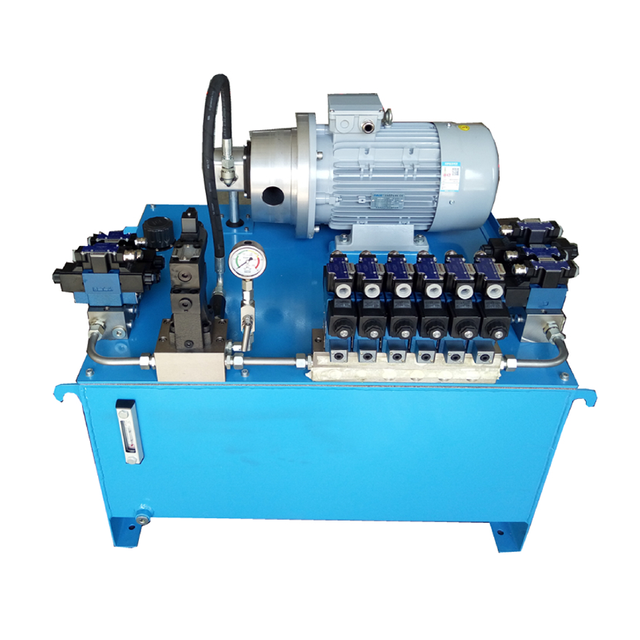
The station combines power generation, hydraulic control, oil storage, filtration, and cooling in one coordinated package, reducing interface errors between separate parts.
Stable output for precise machine behavior
Smooth pressure and flow delivery helps cylinders lift, hold, clamp, press, or position with better consistency.
Energy-saving configuration options
Variable pump solutions can match hydraulic output to load demand, helping reduce unnecessary heat and wasted power.
Compact manifold-based design
Integrated valve block layout reduces external piping, lowers leakage points, and improves serviceability.
Flexible control architecture
From simple electrical control to PLC-based logic and remote monitoring interfaces, the system can be matched to different automation levels.
Thermal and fluid condition support
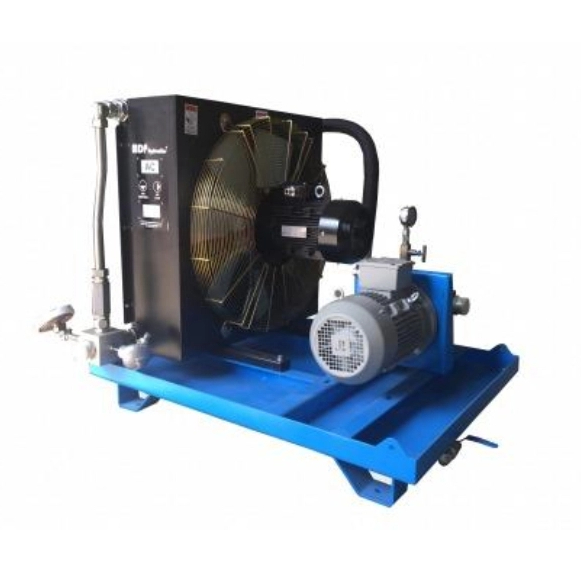
Cooling and filtration options help keep oil clean, temperature-controlled, and suitable for long duty cycles.
Built for challenging environments
Noise control, corrosion resistance, and other special protections can be considered during design for site-specific conditions.
| Rated working pressure | 7 MPa to 35 MPa (can be customized to higher pressures if required) |
| Nominal flow range | 5 L/min to 500 L/min (additional options available for smaller or larger flow rates) |
| Motor power | 0.75 kW to 110 kW (or customizable as per requirements) |
| Control voltage | 24VDC, 110VAC, 220VAC, 380VAC |
| Tank capacity | 20 L to 1000 L or larger (depending on heat dissipation requirements) |
| Pump types | Internal meshing gear pump, vane pump, axial piston variable/push-pull pump / constant-flow pump |
| Control methods | Manual control, relay control, PLC control, intelligent control with IoT function |
| Cooling methods | Air cooling, Water cooling (selected based on the heat dissipation power) |
| Noise level ≤ 70 dB(A) (Standard type, low noise design available) | |
| Protection class IP55 (standard), can be upgraded to IP65/IP6 | |
Industrial equipment rarely works under identical conditions. One machine may need compact vertical installation inside a narrow frame, while another requires a large reservoir, low-noise operation, and stable holding pressure through long cycles. That is why the real value of a non standard hydraulic station lies in matching the hydraulic system to the machine, not forcing the machine to tolerate a generic unit.
This product supports custom design around actual project inputs such as installation space, working pressure, target flow, actuator type, duty cycle, voltage standard, control method, oil tank structure, and maintenance preference. If your equipment requires communication with a host PLC, more centralized valve logic, anti-corrosion treatment, or environmental protections for special operating sites, those factors can be considered from the start.
In practice, this makes a difference in how the system behaves on the floor. A better-matched station is easier to install, cleaner to route, calmer to run, and simpler to inspect later. It also helps shorten commissioning time because the hydraulic power source is prepared around your operating logic rather than adjusted after arrival. For users working with custom presses, automation modules, lifting equipment, metallurgical systems, heavy machinery, or other specialized equipment, that engineering flexibility is often the difference between acceptable performance and dependable performance.
This hydraulic station system can be used in a wide range of industrial environments where hydraulic power must be stable, controllable, and adaptable to real operating demands.
Typical applications include:
Industrial presses and forming equipment
Injection molding and plastic machinery
Metallurgical and heavy-duty equipment
Hydraulic test benches
Lifting and clamping systems
Construction and engineering machinery
Material handling platforms
Marine and offshore auxiliary systems
Agricultural and processing equipment
Automated machinery requiring hydraulic actuation
It is especially suitable for equipment that faces one or more of the following conditions:
Non-standard installation space
Multiple actuators with coordinated movement
High-duty or continuous operating cycles
Pressure holding or locking requirements
Customized control logic
Need for lower leakage risk and easier maintenance
Site conditions involving heat, dust, corrosion, or noise limitations
We focus on system matching, not only component supply
A hydraulic station performs best when pressure, flow, control, and layout are engineered as one solution.
We support deep customization
From pump selection to tank structure, cooling method, control logic, and installation form, the configuration can be tailored around the project.
We emphasize operational reliability
Integrated valve design, controlled fluid routing, filtration, and thermal management all contribute to smoother long-term use.
We understand industrial application diversity
Equipment in metallurgy, automation, lifting, processing, and heavy industry does not share identical requirements, and our design approach reflects that.
We value maintainability
Easy access, clearer layout, and reduced connection complexity help simplify inspection and service over time.
We aim for long-cycle performance
A good hydraulic station should not only run on day one. It should remain stable, clean, and predictable across repeated working cycles.
Yes. The system is designed for custom matching. Pump type, control method, tank layout, cooling, accessories, and special protections can be configured according to application requirements.
Gear pumps, vane pumps, and piston pumps can be selected depending on pressure, flow, and operating characteristics.
Yes. The control system can be configured from basic electrical logic to PLC-based solutions, and communication interfaces can be considered when needed.
It can be designed for continuous or demanding duty cycles with appropriate cooling, filtration, and component selection.
By integrating valves on manifold blocks, optimizing flow paths, and reducing unnecessary pipeline connections.
Yes. Compact and special-shaped layouts can be developed according to machine space and service access requirements.
Pressure, flow, actuator type, voltage, installation space, duty cycle, control requirements, and environmental conditions are the main inputs for matching the right system.