loading
| Availability: | |
|---|---|
| Quantity: | |
PARKER
F1
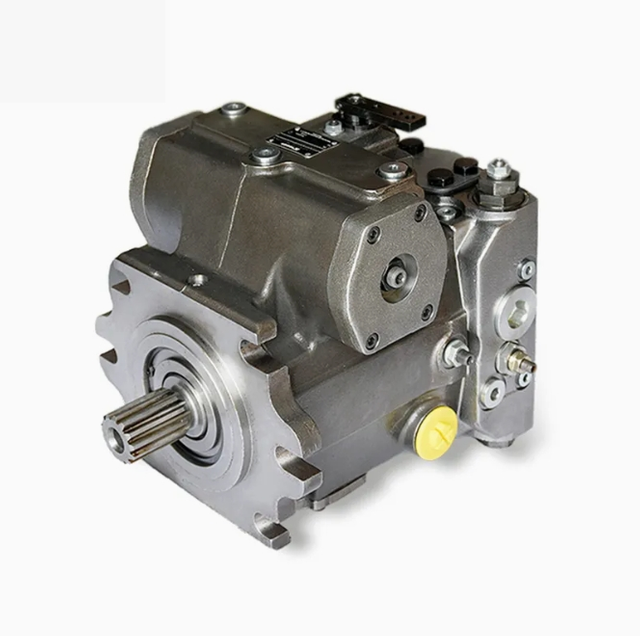
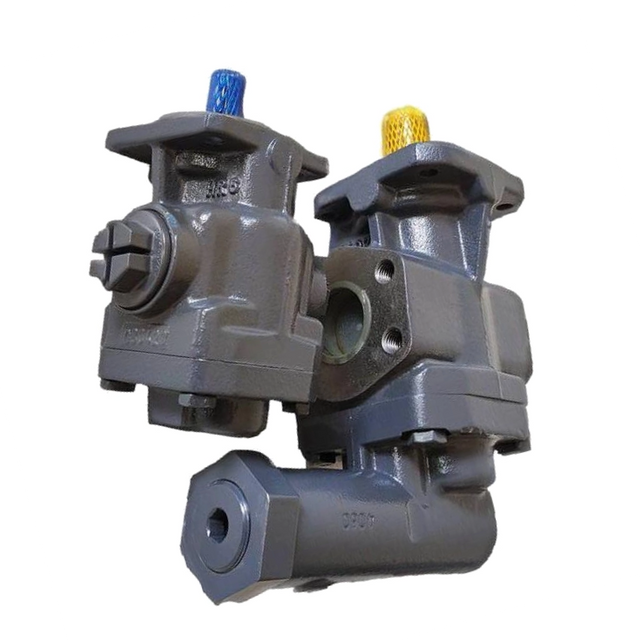
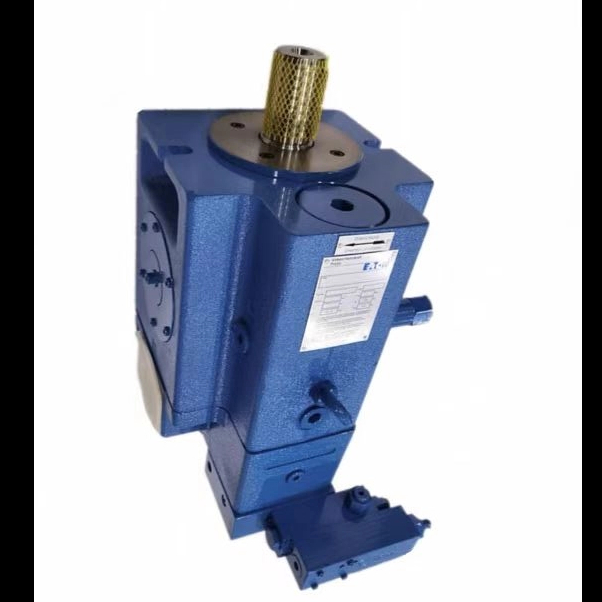
The F1 series fixed-displacement hydraulic piston pump is a type of swashplate axial piston pump specifically designed for heavy mobile machinery (such as dump trucks, concrete mixer trucks, mining trucks, crane chassis). Its key features include a sturdy structure, fixed displacement, high working pressure, and strong shock resistance. It is intended to provide a continuous, stable, and reliable high-pressure hydraulic power source for the working devices of vehicles (such as lifting cylinders, mixing drums). This series of pumps is directly driven by the vehicle's engine or power take-off unit (PTO), and is the "heart" component of the hydraulic system of heavy trucks.
The F1 series pump operates based on the principle of the inclined disc axial piston. The core components include a cylinder body connected to the drive shaft, and multiple pistons evenly distributed around the circumference of the cylinder body. The spherical ends of the pistons are hinged to the sliding shoes, which are tightly attached to the inclined disc surface.
• Suction process: When the drive shaft rotates the cylinder body, due to the fixed inclination angle of the inclined disc, the pistons move in a reciprocating motion within the cylinder while rotating with the cylinder. When the piston extends out of the cylinder, the volume of the cylinder cavity increases, creating a local vacuum, which draws the hydraulic oil into the suction port.
• Oil discharge process: When the plunger is pushed back into the cylinder bore by the swash plate, the volume of the cylinder bore decreases, the oil is compressed, the pressure rises, and it is then forced into the pressure oil circuit of the system through the rectangular window on the valve plate.
• Fixed displacement: Since the inclination angle of the swash plate is fixed and cannot be adjusted at the time of manufacture, the volume of the oil liquid discharged by the pump per revolution (i.e., the displacement) is constant. The output flow is only proportional to the driving speed, and the flow can be adjusted by controlling the speed of the engine or the power take-off device.
Shell: Made of high-strength cast iron or cast steel, it possesses excellent vibration and impact resistance, capable of withstanding the jolts of the truck on rough roads.
Key friction pairs: The piston/cylinder bore pair, the slipper/slipper plate pair, and the valve plate/cylinder block pair are all made of high-strength alloy steel and undergo special heat treatment (such as carburizing, nitriding) and precise grinding to ensure their wear resistance and long service life under high pressure.
The designed working pressure typically covers a continuous range from 21 MPa to 35 MPa, with peak pressure being even higher. At the same time, the allowable input rotational speed range is wide, enabling it to match the entire working range of diesel engines from idle to rated speed.
Forced lubrication and cooling: Internal pressure oil is used to forcibly lubricate and cool the key friction pairs, maintaining a low working temperature even under high pressure and high rotational speed conditions.
Optimized flow distribution design: The flow distributor adopts damping grooves or pre-boosting design, which effectively reduces the pressure shock and noise when the oil transitions from the suction area to the pressure area, thereby improving the volumetric efficiency.
Considering the harsh working environment of heavy vehicles, the internal key gaps of the pump are designed reasonably, and the pump can tolerate relatively high levels of oil contamination (however, the system's filtration accuracy must not be lower than 25μm). The oil suction port usually has a coarse filter screen.
Installation method: Provides flange installation or tripod installation, facilitating connection with the power take-off device or gearbox interface.
Shaft arrangement: Offers spline shafts (flat spline or involute spline) or straight shafts to accommodate various power output configurations.
Rotation direction: Usually, there are models available for either clockwise or counterclockwise rotation.
Some high-end models can integrate an overflow valve (safety valve), a check valve, or a pressure cut-off valve to form a compact pump control unit, simplifying the system piping.
The F1 series pumps are the ideal choice for various heavy-duty trucks that require high-pressure hydraulic power:
• Dump trucks: Provide power for the rear or side lifting cylinders.
• Concrete mixing and transportation vehicle: Drives the mixing drum to rotate, achieving the processes of feeding, mixing, and discharging.
• Vehicle-mounted crane (trailer crane): Acts as the hydraulic power source for the crane.
• Sanitation vehicles: Used for garbage compression and cleaning equipment.
• Oilfield special vehicles: Used for equipment such as well drilling machines and fracturing vehicles.
• Other heavy-duty specialized vehicles: such as aerial work platforms, rescue vehicles, and the chassis parts of concrete pump trucks.
Correct selection is the key to ensuring system compatibility and reliability:
Required flow rate (Q): Calculated based on the speed and size of the actuator (cylinder). Formula: Q (L/min) = Cylinder required speed (m/s) × Cylinder effective area (cm²) × 6. Considering system leakage, add a 10%-15% margin.
System working pressure (P): Calculate the maximum thrust required for the actuator based on the load, and then determine the corresponding pressure.
Based on the flow rate requirement and the expected driving speed (n) (in rpm), calculate using the formula: Pump displacement (cc/rev) = [Q (L/min) × 1000] / n. Choose the standard displacement model that is closest.
Ensure that the vehicle engine or power take-off unit has sufficient power output. Formula: Driving power (kW) ≈ [P (MPa) × Q (L/min)] / 60. Divide by the total efficiency of the pump (approximately 0.85) to obtain the input power requirement.
Select the matching shaft extension and installation method based on the output shaft type (bevel gear specification, rotation direction) and installation space of the power take-off unit.
In extremely cold regions, pay attention to the pump's low-temperature start-up performance and may need to use low-viscosity oil or equip a preheating device.
Crucial for alignment: The drive shaft of the pump and the output shaft of the power take-off unit must be highly coaxial (typically requiring a deviation of less than 0.1mm), and an elastic coupling should be used to avoid radial forces. Otherwise, it will cause damage to the shaft seal and premature wear of the bearings.
Firm support: The installation brackets must have sufficient rigidity to prevent the pump body from experiencing additional stress due to vibration.
Oil suction pipeline: The oil suction pipe should be short and straight, with a sufficient pipe diameter to ensure low suction resistance. It is absolutely essential to avoid exposing the suction port above the liquid surface or allowing air to be sucked in.
Filling with oil: Before the first startup, the pump housing must be filled with clean hydraulic oil through the drain port or the exhaust valve.
Idle running-in: After starting, the system should be operated at idle speed or at the lowest pressure for several minutes to allow the oil to fill the system and to expel any air.
Monitoring: Pay attention to listening for any abnormal noise from the pump during operation, check for any leakage at the shaft seal, and monitor the oil temperature.
Oil and filtration: Use the specified viscosity grade of clean hydraulic oil strictly in accordance with the requirements, and replace the filter element regularly. Oil contamination is the main cause of pump failures.
Regular inspection: Check the alignment of the coupling, whether the fastening bolts are loose, and whether the oil inlet and outlet pipe joints are leaking.
Fault symptoms: If there is a significant increase in noise, a decrease in output flow, severe oil leakage from the shaft seal, or an abnormal increase in the temperature of the shell, the machine should be immediately shut down for inspection.
| Fault phenomenon | Possible causes | Solutions |
| Unable to pump oil or insufficient flow | 1. The suction pipe is leaking or clogged. 2. The oil level in the tank is too low. 3. The rotation direction of the pump is incorrect. 4. The pump is severely worn internally and has a low volumetric efficiency. | 1. Check and tighten the suction pipe line to ensure a seal. 2. Add oil to the specified level. 3. Correct the driving rotation direction. 4. Repair or replace the pump. |
| Pressure cannot be established or is too low | 1. The set value of the system safety valve (overflow valve) is too low or damaged 2. There is excessive internal leakage in the pump (such as wear of the flow distributor). 3. The driving speed is too low. | 1. Check and adjust the safety valve. 2. Repair the pump. 3. Increase the engine speed. |
| Abnormal noise and vibration | 1. Insufficient oil intake, causing cavitation (sharp screeching sound). 2. Poor alignment between the pump and the drive shaft. 3. Damaged bearings. 4. A large amount of air mixed in the oil. | 1. Check the oil intake pipeline, filter, and oil viscosity. 2. Re-align and correct alignment. 3. Replace the bearings. 4. Remove air from the system and inspect the pipeline seals. |
| Excessive heat in the pump body or shaft seal | 1. Inappropriate viscosity of the oil or deterioration of the oil quality 2. Long-term operation under overpressure or overspeed conditions. 3. Abnormal wear of internal friction pairs. 4. Insufficient cooling. | 1. Replace with clean oil of the appropriate viscosity. 2. Check the system pressure setting and operating conditions. 3. Repair the pump. 4. Check the capacity of the oil tank and the cooler. |
| Oil leakage at the shaft seal | 1. The shaft seal is aging or damaged. 2. The oil drainage pipeline is blocked, causing excessive pressure inside the casing. 3. The shaft and bearing are worn, with excessive clearance. | 1. Replace the shaft seal. 2. Clear the oil drainage pipe (usually return to the oil tank directly, without back pressure). 3. Inspect and replace the worn parts. |
The F1 series fixed-displacement piston pump is designed and tested in accordance with the standards of the heavy vehicle industry. Before leaving the factory, the product undergoes rigorous performance tests (pressure-flow characteristics, efficiency), durability tests and sealing tests. The manufacturer can provide products that comply with the technical specifications of specific vehicle manufacturers (OEM). For precise installation dimensions, performance curves and warranty terms, please refer to the official technical manual of the model you purchased.
| Size F1- | 25 | 41 | 51 | 61 |
| Displacement [cm3/rev] | 25.6 | 40.9 | 51.1 | 59.5 |
| [cu in/rev] | 1.56 | 2.50 | 3.12 | 3.63 |
| Max flow 1) [l/min] | 67 | 98 | 112 | 131 |
| [gpm] | 17.7 | 25.9 | 29.6 | 34.6 |
| Max operating pressure [bar] | 350 | 350 | 350 | 350 |
| [psi] | 5000 | 5000 | 5000 | 5000 |
| Mass moment of inertia J [kgm2] | 0.00274 | 0.00266 | 0.00261 | 0.00257 |
| Shaft speed [rpm] | ||||
| - short circuited pump (low press.) | 2700 | 2700 | 2700 | 2700 |
| - max speed at 350 bar2)/5000 psj 2)) | 2600 | 2400 | 2200 | 2200 |
| Torque 1) | ||||
| at 350 bar [Nm] | 142 | 227 | 284 | 331 |
| at 5000 psi [Ibf ft] | 105 | 168 | 210 | 244 |
| Input power | ||||
| [kW] | 30 | 57 | 66 | 76 |
| [hp] | 52 | 76 | 88 | 102 |
| Weight [kg] | 8.5 | 8.5 | 8.5 | 8.5 |
| [lbs] | 18.7 | 18.7 | 18.7 | 18.7 |

A1: The F1 series is a type of vane-type axial piston pump. Its core feature is that the displacement is fixed. This means that the volume of oil output by the pump per full rotation is constant. It is specifically designed for heavy-duty mobile machinery (such as dump trucks, mixer trucks), and its core advantage lies in its sturdy structure, resistance to impact, high working pressure (typically 25-35 MPa), strong reliability, and the ability to directly draw power from the vehicle engine, providing stable power for lifting and mixing operations.
A2: The selection should be based on your system requirements and vehicle conditions. The key parameters are as follows:
1. Displacement (cc/rev): This determines the pump's output flow rate. Calculate the required flow rate (L/min) based on the speed and size of the hydraulic cylinder, and combine it with the common operating speed of the power take-off (PTO) (rpm). Use the formula Displacement = (Flow × 1000) / Speed to calculate and choose the closest standard displacement (such as 40, 55, 80, 100, 130, etc.).
2. Rated working pressure (MPa): It must be greater than or equal to the maximum working pressure required by the hydraulic system's actuator.
3. Interface and rotation direction: It must be fully compatible with the output shaft type (bevel gear specification) of the vehicle's power take-off (PTO), the rotation direction (clockwise or counterclockwise), and the installation interface (flange or tripod).
A3: The alignment of the drive shaft is the key to the success of the installation. The input shaft of the pump and the output shaft of the power take-off unit must be highly coaxial (typically requiring a radial deviation of less than 0.1mm), and an elastic coupling must be used for connection to compensate for minor deviations. Poor alignment will immediately lead to oil leakage from the shaft seal and damage to the bearings. In addition, the suction pipeline should be short and thick to ensure smooth oil intake, and the pump shell should be filled with oil before the first start-up.
A4: This is typically a sign of cavitation. The main reasons include:
• Insufficient oil intake: The suction pipe is too long, too thin, clogged, or leaking.
• Oil issue: Low oil temperature leads to high viscosity, or oil contamination causes the oil filter screen to become clogged.
• Fuel tank issue: Insufficient fuel level or the fuel inlet is exposed above the liquid surface.
Cavitation can cause severe damage to the internal components of the pump. The machine must be immediately shut down for inspection and the aforementioned problems must be resolved.
A5: Please follow the following sequence for troubleshooting:
1. Check the basic items: Confirm that the oil level in the oil tank is sufficient and that the rotation direction of the pump is correct (from the end of the shaft, it is usually consistent with the rotation direction of the power take-off device).
2. Check the suction side: Check if there is air leakage in the suction pipeline and if the filter is clogged.
3. Check the system side: Check if the set pressure of the system overflow valve (safety valve) is too low or if the valve core is stuck.
4. Check the pump itself: If all of the above are normal, it may be that the pump has suffered severe internal wear (such as wear of the flow distributor plate and piston pair), resulting in excessive internal leakage. In this case, it is necessary to perform maintenance or replacement.
A6: The main difference lies in the way of controlling the output flow:
• F1 fixed-displacement pump: The output flow is only proportional to the driving speed. To change the speed of the actuator, the pump's speed needs to be adjusted by changing the engine throttle. The advantages are simple structure, low cost, shock resistance, and high reliability.
• Variable pump: The displacement can be adjusted within a certain range. Even if the rotational speed remains constant, the output flow can be changed. The advantage is that it has a good energy-saving effect (providing oil as needed) and offers more flexible control.
How to choose: For applications such as self-unloading truck lifting and mixer truck drum drive, where the load is relatively stable, cost is a key consideration, and ultimate reliability is pursued, the fixed-displacement pump (F1) is a more classic and economical choice. For systems with complex working conditions, the need for frequent speed adjustment, and high energy consumption requirements, variable pumps can be considered.
A7: Remember the three key points:
1. Keep the oil clean: This is the most important! Use the specified brand and viscosity of hydraulic oil (typically recommended as ISO VG46 or VG68), and ensure the system filtration accuracy (suggested to be no less than 25μm), and replace the filter element regularly.
2. Avoid extreme conditions: Try to avoid running for a long time under overpressure, over-speed, or extremely low rotational speed. After starting, run at idle speed for a few minutes first.
3. Regular inspection: Regularly check the alignment of the coupling, the tightening of the bolts, whether there is any leakage at the inlet and outlet pipes and the shaft seal. Listen to whether the running sound is smooth.
A8: Common causes of shaft seal oil leakage are as follows:
1. Aging and damage of the shaft seal: Due to long-term use, it will naturally wear out or the rubber will age.
2. Blockage of the oil drainage pipeline: If the return pipeline of the oil outlet on the pump housing is blocked, it will cause an increase in pressure inside the pump housing, forcing the oil to leak out from the shaft seal.
3. Wear of the bearings or poor alignment: This can lead to excessive radial movement of the pump shaft, accelerating the wear of the shaft seal.
A9: Low temperatures significantly increase the viscosity of the oil, making it difficult to draw in oil and causing cavitation and start-up wear.
• Oil selection: Use hydraulic oil with a low freezing point and good low-temperature fluidity (such as HV or HS low-temperature resistant hydraulic oil).
• Preheating startup: After starting the engine, the hydraulic system should run at a low speed without load or with a very low load for a period of time to allow the oil temperature to naturally rise to the normal operating range (recommended above 15°C). Then, it should be put into full-load operation. If possible, an oil preheating device can be installed.
A10: To ensure quality and compatibility, we strongly recommend:
1. Purchase through authorized channels: Contact the original equipment manufacturer (OEM) or the authorized dealers and service providers of the pump brand.
2. Provide complete information: When ordering spare parts or seeking support, please provide the complete model nameplate and serial number on the pump body. This is the only basis for obtaining the correct parts.
3. Refer to official materials: Maintenance and debugging should strictly follow the "User Manual" or official technical manuals that come with the pump. For complex faults, providing detailed fault phenomena and system parameters will help technicians diagnose quickly.