Views: 0 Author: Site Editor Publish Time: 2025-11-04 Origin: Site
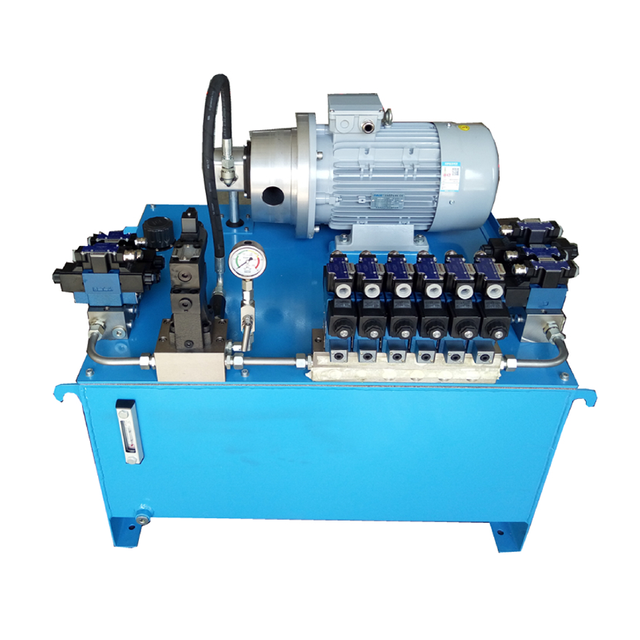
The hydraulic station is also known as the hydraulic pump station. The motor drives the oil pump to rotate. The pump sucks oil from the oil tank and discharges it. It converts mechanical energy into the pressure energy of the hydraulic oil. The hydraulic oil passes through the integrated block (or valve combination) and is regulated in terms of direction, pressure and flow by the hydraulic valve, and then is transmitted through the external pipeline to the oil cylinder or oil motor of the hydraulic machinery. Thereby, it controls the transformation of the direction of the hydraulic mechanism, the magnitude of the force and the speed of the acceleration, and drives various hydraulic machinery to perform work.
The hydraulic station is an independent hydraulic equipment. It supplies oil according to the requirements of the driving equipment (main unit) and controls the direction, pressure and flow of the oil. It is applicable to various hydraulic machinery where the main unit and the hydraulic equipment can be separated. It is driven by an electric motor to rotate the oil pump. The pump sucks oil from the oil tank and then pumps it out, converting mechanical energy into the pressure energy of the hydraulic oil.
After purchase, simply connect the hydraulic station to the actuators (cylinders and oil motors) on the main unit with oil pipes, and the hydraulic machinery can perform various regular movements and operation cycles.
The structural approach for the hydraulic station planning is mainly distinguished by the structure of the pump equipment, the equipment location, and the cooling method. One type is the top-mounted type, and the other is the horizontal-mounted type.
Structural equipment - According to the mechanism of the pump equipment and its installation position, it can be classified as:
1) Top-mounted type: The pump equipment is installed vertically on the oil tank cover, primarily used in the quantitative pumping system.
2) Top-mounted horizontal type: The pump equipment is placed horizontally on the oil tank cover. It is mainly used in variable pump systems to facilitate flow regulation.
3) Side-mounted type: The pump equipment is a horizontal device placed beside the oil tank. The side-mounted type can be equipped with a backup pump, primarily used in systems with an oil tank capacity of over 250 liters and an electric motor power of 7.5 kilowatts or more.
Cooling method
1) Natural cooling: It is cooled by the heat exchange between the fuel tank and the air. This method is typically used in systems with a fuel tank capacity of less than 250 liters.
2) Forced Cooling: Implement forced cooling using a cooler. This method is typically used in systems with an oil tank capacity greater than 250 liters. The hydraulic station takes the effective oil storage capacity of the oil tank and the motor power as its primary technical parameters. There are a total of 18 standard oil tank capacities (units: liters/L): 25, 40, 63, 100, 160, 250, 400, 630, 800, 1000, 1250, 1600, 2000, 2500, 3200, 4000, 5000, 6000. This series of hydraulic stations can meet the following requirements based on user requirements and operating conditions: ① According to the system equipment integration blocks, or without integration blocks; ② Cooling devices, heaters, accumulators can be set; ③ Electrical control equipment can be installed, or without electrical control equipment.
Fuel tank method
1) General steel plates: The box body is made by welding 5MM-6MM steel plates, and the panel is made of 10-12MM steel plates. If there are too many openings, the thickness can be appropriately increased or additional reinforcement ribs can be added.
2) Stainless steel plates: The box body is made of 304 stainless steel plates with a thickness of 2-3MM, and the panels are also made of 304 stainless steel plates with a thickness of 3-5MM. Reinforcing ribs are added to the load-bearing areas.
3) The internal rust prevention treatment for ordinary steel tanks is quite difficult to achieve. Rust entering the oil circulation system can cause many problems. By choosing an all-stainless steel tank design, this industry challenge has been overcome.